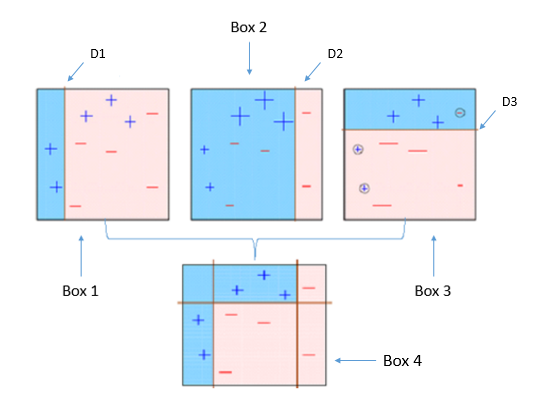
Boosting in another ensembling method of creating a strong learner from various weak learners.
Basic idea
It is a sequential method in which the learners are created in a sequential manner and the errors/misclassifications from the previous model/learner
are given a higher weight to be included in sample that will be selected for training the next learner/model.
This goes on till a condition is met such as batch size or the time reached.
Algorithm
Why Boosting works?
Each new model will be attempting to fit the error of all of the previous models combined. As we are continuoously creating new residuals, by subtracting the predictions of each new model from the residuals from the previous model, the residuals will get smaller and smaller and thus prediction will get stronger.
To make predictions with an ensemble of boosted trees, we calculate the predictions from each tree, and then add them all together. Also, Boosting unlike Bagging can overfit a lot. Bagging doesn’t overfit because trees aren’t correlated while in Boosting, one model is dependent on all the previous ones.